

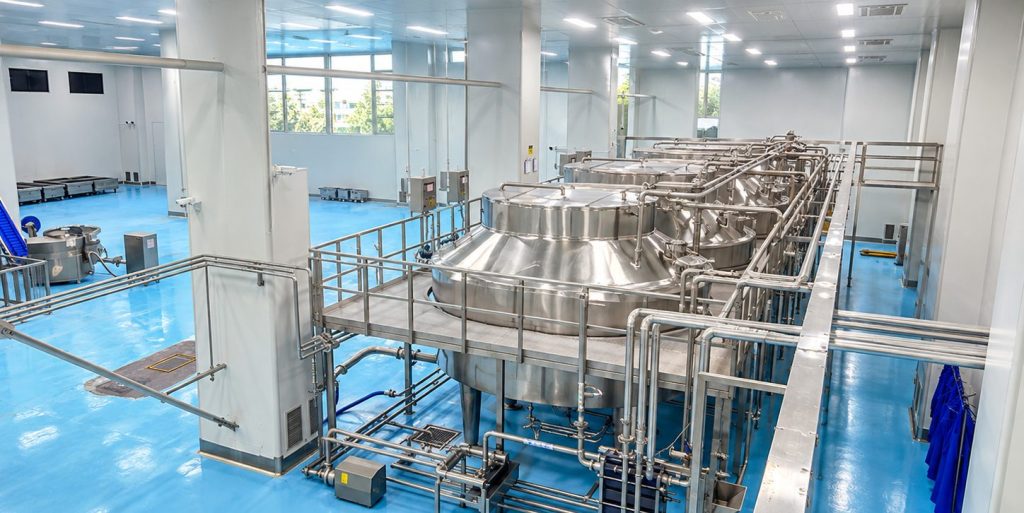
Introduction | Why Can the Same Milk Produce Mozzarella with Very Different Performance?
Mozzarella cheese is widely used in pizza, bakery products, foodservice and industrial food processing. For low-moisture pizza mozzarella in particular, producers and buyers are concerned not only with food safety, moisture content and salt level, but also with melting performance, stretchability, oil release, browning and batch-to-batch consistency.
These properties are not determined by the stretching machine alone.
Every processing stage—from raw milk composition, curd formation and whey drainage to curd acidification, cooking and stretching, cooling and salting—can affect the final cheese.
The real value of an industrial mozzarella production line lies in bringing pH, temperature, moisture, residence time and mechanical treatment intensity under repeatable process control.
Based on observations from a large-scale cheese production facility together with dairy engineering principles, this article explains the key processing stages, equipment functions and production-line design logic, while also discussing what small and medium-sized cheese plants can learn from large industrial operations.
01 | Overview of the Industrial Mozzarella Production Process
Mozzarella belongs to the Pasta Filata, or stretched-curd, family of cheeses. After the curd reaches the appropriate level of acidification, heating and mechanical stretching reorganize the casein network, creating the characteristic fibrous structure of the cheese.
For industrial production, the overall process can be understood in seven main stages:
1.Raw Milk Pretreatment — Milk reception → filtration → composition testing and, where necessary, standardization → pasteurization → process cooling.
2. Curd Preparation — Starter culture and rennet addition → coagulation → cutting → agitation → heating → initial whey drainage.
3. Curd Conditioning — Whey pre-drainage → continued drainage → curd matting and acidification → pH monitoring → milling and conditioning.
4. Cooking and Stretching — Curd conveying → heating and softening → kneading and stretching → fibrous structure development.
5. Forming and Cooling — Extrusion or mould forming → controlled cooling → product setting.
6. Salt Adjustment and Packaging — Depending on the process, salt may be added through dry salting, brining or another suitable method, followed by cutting, shredding and packaging.
7. Cold Storage and Product Release — Temperature-controlled storage → physicochemical, microbiological and application-performance testing → release for shipment.
The position of the salting step, cooling method and storage conditions may vary depending on the mozzarella type and equipment configuration. This process sequence should therefore be understood as an engineering framework rather than a single equipment arrangement applicable to every mozzarella product.
02 | Raw Milk Processing: Stable Cheese Production Starts with Raw Material Quality
The fat, protein, calcium balance and microbiological quality of raw milk directly influence curd strength, whey drainage, cheese yield, process stability and product safety.
A properly designed milk reception system should therefore consider more than simply installing a milk transfer pump. It may need to include milk measurement, filtration, temporary storage, sampling and testing, and composition standardization where required.
Plate pasteurization reduces relevant microbiological risks through controlled heat treatment. A commonly used HTST condition is approximately 72°C for 15 seconds, but actual operating conditions should be determined according to applicable regulations, raw milk condition, the target cheese and validation results. After pasteurization, milk is cooled through the heat-exchange system to the temperature required for cheesemaking. Some formulations may operate around 30–32°C, but this should not be treated as a universal optimum for all starter cultures or mozzarella recipes.
When selecting a pasteurization system, nominal throughput alone is not enough. Important engineering checks include holding time, flow monitoring, temperature recording, diversion of non-conforming product, heat recovery and CIP coverage. Where a continuously operating pasteurizer feeds batch cheese vats, the production line also requires a properly designed feeding sequence or buffering strategy to prevent interruptions between continuous and batch processes.
03 | Cheese Vats: How Do Batch Processes Connect with Continuous Production?
Inside the cheese vat, starter cultures drive acidification while rennet promotes the formation of the milk-protein gel. The curd is then cut, agitated, heated and partially drained of whey until it reaches the condition required for downstream processing.
Large industrial plants may use multiple cheese vats, including double-O or other high-capacity designs, operating on staggered batch schedules to provide a more continuous supply of curd to downstream equipment.
The actual capacity of the line is not determined by vat volume alone. It also depends on effective milk filling volume, coagulation time, cutting time, discharge time, cleaning and preparation time, and the start-time interval between individual vats.
Continuous curd matting, draining and stretching systems require a relatively stable material supply. For this reason, industrial projects should include a batch schedule, buffering arrangements and the necessary process interlocks.
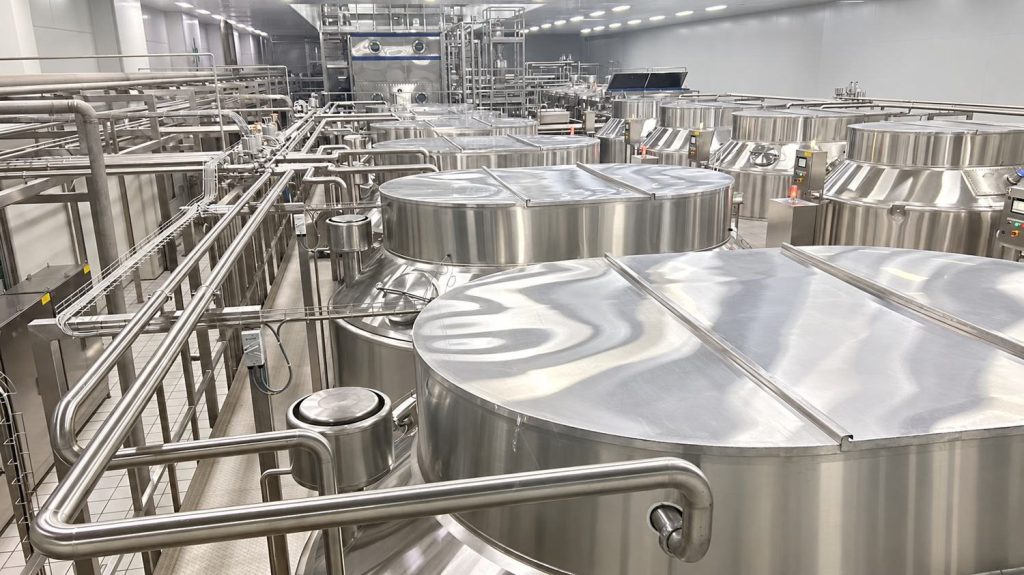
During the referenced plant visit, the production area was reported to contain 12 cheese vats, with the supplied operating figures indicating approximately 15 tonnes per batch per vat, approximately 4 hours per batch and 5 batches per day. Based on these figures, the corresponding batch-processing capacity of this vat group would be approximately 900 tonnes per day.
However, the separately stated whole-plant raw milk processing capacity of 2,000 tonnes per day should not be directly attributed to this specific group of vats without production records and clarification of the process scope. Before formal publication or project comparison, production reports and a clear definition of the applicable processing line should be obtained.
04 | Whey Drainage and Continuous Curd Matting: Controlling Moisture, Acidification and Curd Condition
After discharge from the cheese vat, the curd still contains a substantial amount of free whey. Continuous whey pre-drainage and curd matting systems may use perforated conveyor belts, controlled curd-bed thickness and conveying mechanisms to continue whey removal while allowing the curd to acidify under controlled temperature and residence-time conditions.
Some systems may also integrate curd loosening and levelling, milling, dry-salt mixing and conditioning modules. The exact arrangement depends on the target product and equipment design.
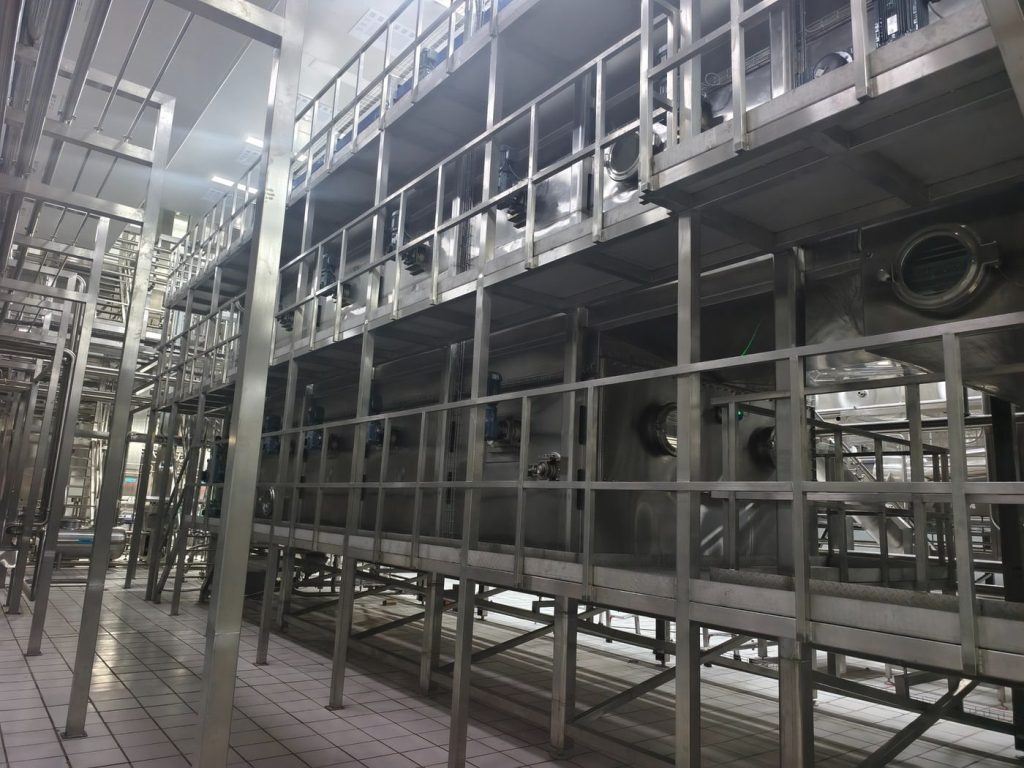
As lactic acid bacteria continue producing acid, the curd pH gradually decreases. This also changes the interaction between casein and calcium, which directly affects the curd’s ability to plasticize during the subsequent heating and stretching stage. Many mozzarella processes control pre-stretch curd pH at approximately 5.2–5.4. However, the optimum value also depends on calcium content, moisture level, formulation and the required final product characteristics. If pH is too high or too low, stretching performance, texture and end-use functionality may become unstable.
For the line observed during the plant visit, the supplied process conditions included a residence time of approximately 90–120 minutes, an inlet pH of approximately 5.8–6.0 and an outlet pH of approximately 5.2–5.3. These figures should be treated as values associated with that specific process, not as universal industry standards. Project owners should ask equipment suppliers to clarify where pH is measured, whether monitoring is online or manual, actual material loading and the adjustable operating range of the equipment.
If dry salt is added after curd matting, the salting point should normally be confirmed relative to completion of the required acidification. Salt can inhibit continued activity of lactic acid bacteria, so dry-salt addition and brine concentration should not simply be combined arithmetically to estimate final cheese salt content.
05 | Cooking and Stretching: The Key Stage in Developing Fibrous Structure
Cooking and stretching is one of the defining stages of Pasta Filata cheese production. Once the curd has reached the appropriate acidification state, it is heated until it becomes plastic and is then kneaded and stretched by screws, paddles or other mechanical systems.
The objective is not simply to heat the curd. The purpose is to develop the required cheese structure under the correct combination of moisture, pH, temperature, mechanical action and residence time.
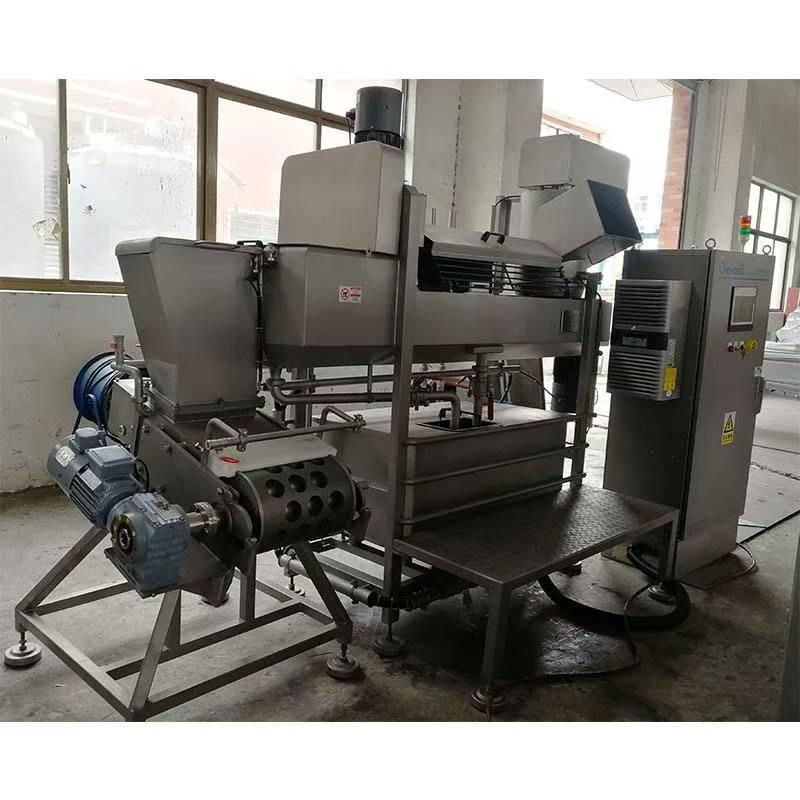
Three factors deserve particular attention: the curd condition before entering the stretching machine; the difference between heating-medium temperature and actual curd temperature; and the relationship between feed rate, equipment speed and residence time.
The observed process data indicated a curd temperature of approximately 60–68°C. This may be useful as a reference value for evaluating that particular production line, but it should not be presented as the optimum stretching temperature for all mozzarella products.
Different machines may use direct hot-water contact, steam or indirect heat transfer. Suppliers should therefore provide clear information on the heating principle, product temperature measurement points, water consumption, energy consumption and CIP boundaries. The forming stage should also be validated together with the specific mould, outlet configuration and cheese formulation.
06 | Cooling, Salting and Packaging: Stabilizing Product Specification and Quality
After stretching, mozzarella remains warm and plastic. Extrusion, moulding and cooling are used to establish the structure required for cutting, shredding, packaging, storage and downstream use.
Cooling-system design should take into account product mass flow per hour, product temperature entering the cooling system, product thickness, cooling-water temperature, water flow and target discharge temperature. It is therefore not technically sufficient to judge cooling performance simply by stating that the water temperature is below 10°C.
Salt affects more than flavor. It also influences moisture distribution, microbial activity and protein structure. Dry salting, brining and other salting methods each have different process applications.
Brine management should consider brine concentration, temperature, pH, microbiological condition and immersion time. The Baumé degree (°Bé) is a density-related reading and should not be treated as identical to NaCl mass percentage. A value of approximately 20–22°Bé was supplied for the observed process, but before publication or project acceptance it should be checked against instrument calibration and measurement temperature.
Low-moisture mozzarella for pizza applications is commonly cooled, cut into blocks or shredded, packaged and stored under refrigeration. Packaging format and cold-storage conditions depend on product positioning, shelf-life requirements and downstream application. Cheese structure may continue to change during refrigerated storage, so melting and stretch performance should ultimately be evaluated through actual application testing.
07 | The Core of Industrial Production: Material Balance, Production Rhythm and Automation
Large-scale mozzarella production lines often combine batch curd production at the front end with continuous curd matting and stretching downstream.
Incoming raw milk flow, batch curd output, curd flow leaving the matting section and final cheese output should not be treated as interchangeable figures. This is because mass is transferred and removed during whey drainage, salting, cooking and stretching, and cooling.
For example, an initial project concept based on 30 tonnes of raw milk per hour and approximately 3 tonnes of finished cheese per hour would suggest a theoretical milk-to-cheese ratio of about 10:1. However, a proper material balance must separately account for whey, curd, moisture, salt and process losses. Likewise, a stretching machine rated at 3,000 kg/h does not automatically mean the complete line can produce 3,000 kg/h of finished mozzarella under every formulation and operating condition.
Engineering documentation should therefore include a complete material balance, batch timing schedule, equipment load profile and switching strategy during CIP. The automation system should record key process information such as temperature, pH, flow, production timing and alarms, and link these data to finished-product quality tracking. Stable production capacity should ultimately be demonstrated through operating tests and acceptance data under clearly defined conditions.
08 | What Can Small and Medium-Sized Mozzarella Plants Learn from Large Industrial Lines?
Investors planning a cheese plant processing approximately 1,000–5,000 L of milk per day do not need to copy the large-scale factory model. A smaller plant usually does not require long continuous curd-matting systems, long-distance conveyors or multi-level operating platforms. However, the underlying engineering principles remain the same: moisture control, acidification endpoint, cooking and stretching conditions, hygienic design and production rhythm.
The first step is to define the target cheese. Will the plant produce fresh mozzarella, low-moisture pizza mozzarella, semi-hard cheese, matured cheese, or several products on the same line?
The second step is to determine daily milk volume, number of production batches, cheese-vat capacity and operating mode of the stretching equipment. The third step is to include supporting utilities and facilities in the investment plan, including hot water, refrigeration, CIP, wastewater treatment, packaging and, where required, maturation space.
Multi-product plants also need to distinguish carefully between shared equipment and product-specific equipment. Different cheeses may share raw milk handling, pasteurization and some curd-processing equipment. However, Pasta Filata cooking and stretching is not required for every cheese type. Cleaning and changeover time between products can also significantly affect actual daily output. A practical solution should therefore balance current investment budget, production flexibility and future expansion potential.
09 | Eight Questions to Ask Before Purchasing a Mozzarella Production Line
1. Does the stated capacity refer to raw milk flow, curd flow or final cheese output?
2. Is the target product fresh mozzarella or low-moisture mozzarella for pizza applications?
3. Which key stages operate in batch mode and which operate continuously, and how are production cycles synchronized?
4. How are curd pH, temperature, moisture and stretching condition monitored?
5. Can the supplier provide a material balance covering whey, curd, finished cheese and process losses?
6. How long does product changeover take, and which product-contact surfaces are covered by CIP?
7. Are utilities, control systems, installation, commissioning and spare parts included in the supply scope?
8. Can the supplier provide a process flow diagram, batch timing schedule and references from similar operating projects?
Conclusion | A Good Mozzarella Line Starts with Correct Process Planning
Industrial mozzarella production is not simply a matter of connecting a cheese vat, curd-matting system and stretching machine. It requires raw milk quality, acidification, whey drainage, stretching, salting, cooling and packaging to be treated as one integrated processing system.
Large industrial projects focus heavily on continuity, automation and stable production capacity. Small and medium-sized projects place greater emphasis on appropriate scale, production flexibility and capital efficiency. Equipment capacity can be scaled. The process logic that determines cheese quality cannot be ignored.
DAIROOL focuses on equipment configuration and integrated solutions for raw milk handling and cheese processing. If you are planning a new cheese plant or upgrading an existing facility, useful starting information includes daily raw milk volume, target cheese types, available plant space and utilities, and investment objectives. These inputs can be used to develop an initial process concept and equipment configuration for further technical discussion.
DAIROOL — Dairy Processing Equipment & Integrated Solutions
This article is intended for technical discussion of dairy processing and equipment selection. Specific process parameters, equipment configuration and project scope should be confirmed according to actual production requirements, test results and final technical documentation.