
Short answer: roughly 0.9 to 1.3 tons of powder — not a fixed number. The exact milk powder yield depends on the type of powder you make (whole vs skim), the solids content of your milk, and the fat you separate out. Most people assume the answer is a fixed “1.1 tons,” but that is only one scenario.
If you are planning a small or medium milk powder production line, this article gives you the complete calculation, the three powder scenarios, and — most importantly — how this one number determines the size of your evaporator and spray dryer (and therefore your budget).
TL;DR — The Answer Up Front
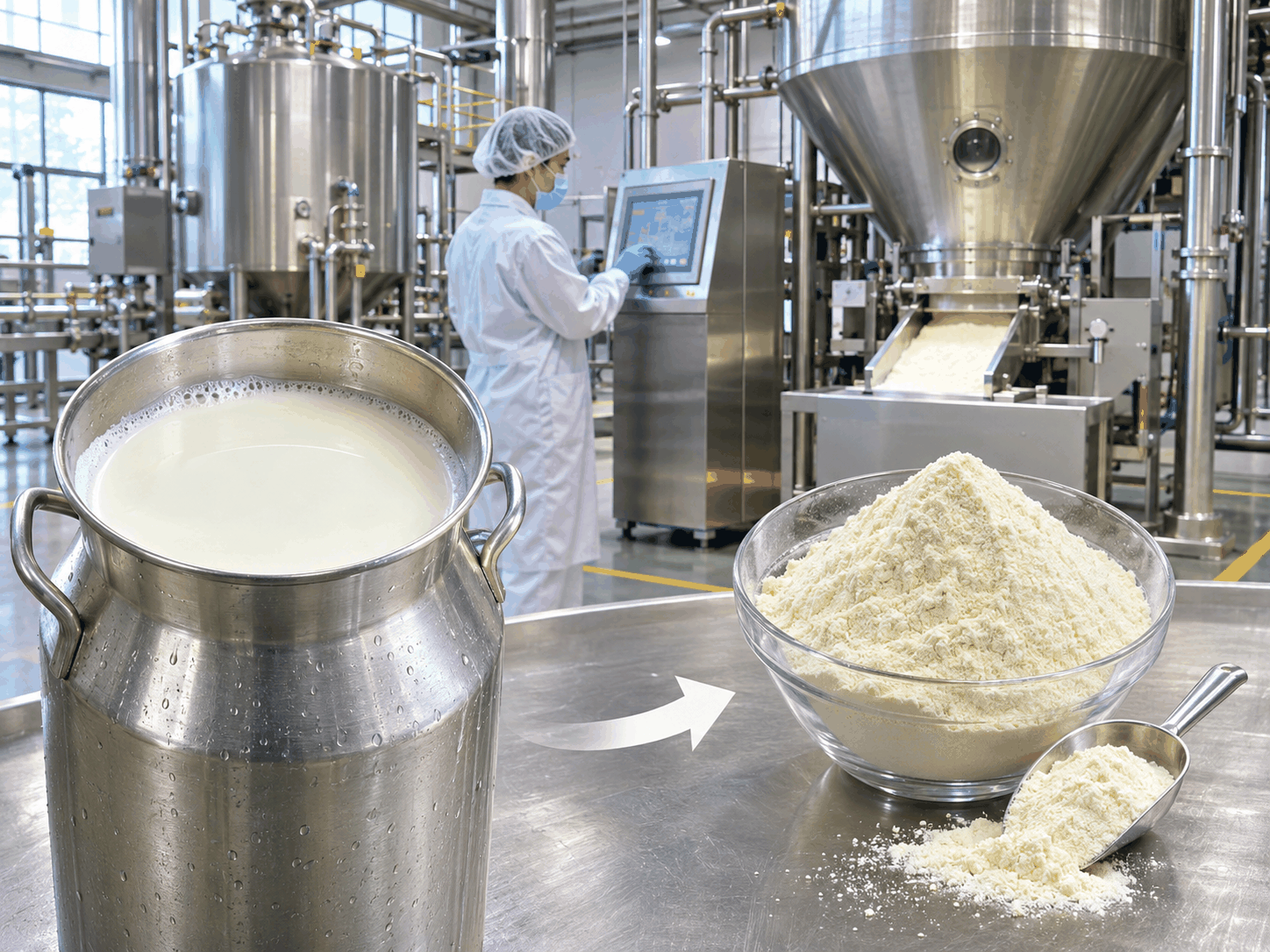
The yield range of 0.9–1.3 tons comes from two variables: the fat separation and the solids content of your raw milk.
1. Why 10 Tons Becomes ~1 Ton: The Milk Composition
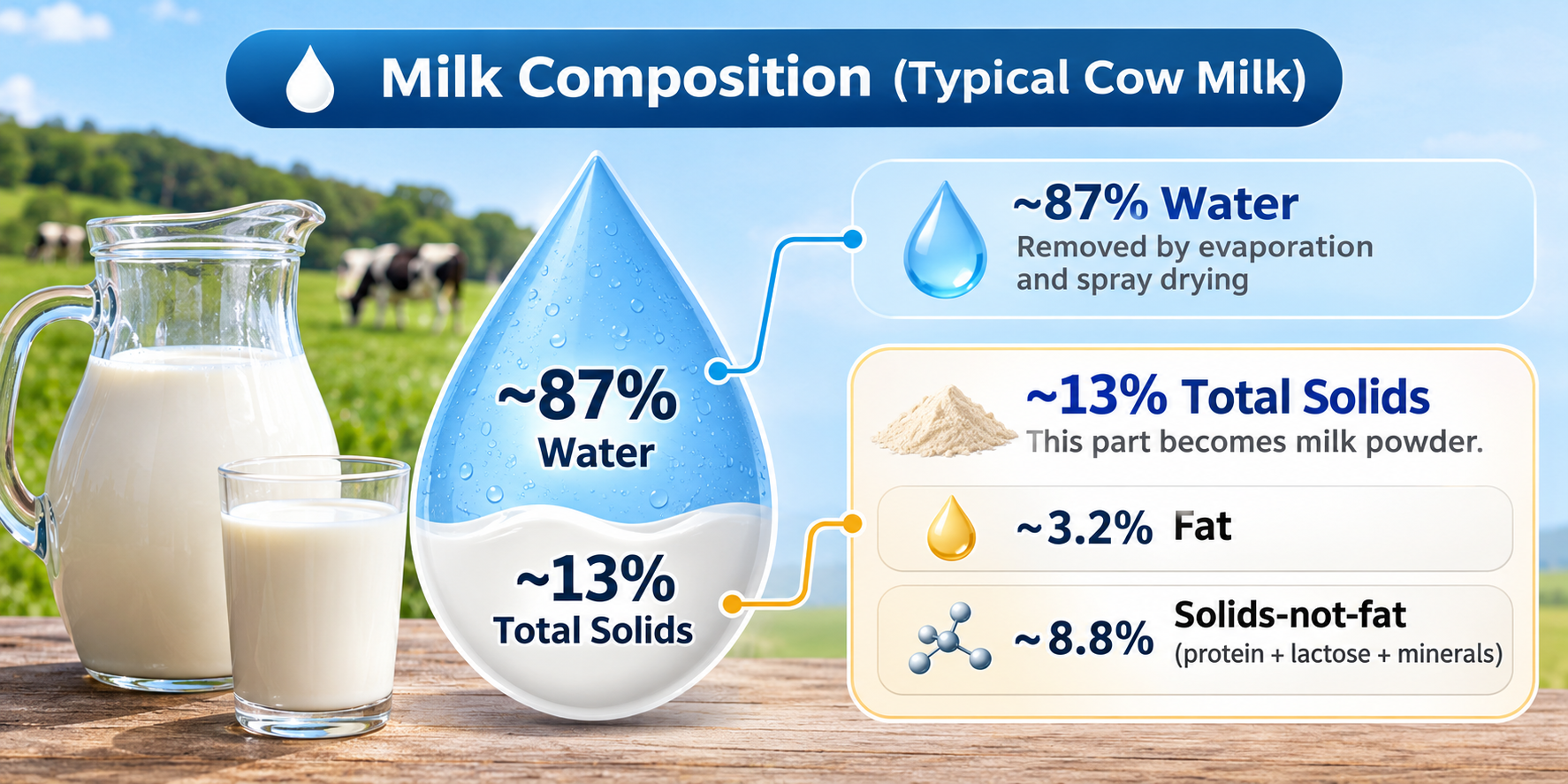
Fresh cow milk is mostly water. On a typical basis:
| Component | Typical share |
|---|---|
| Water | ≈ 87% |
| Fat | ≈ 3.2% |
| Solids-not-fat (protein + lactose + minerals) | ≈ 8.5–8.8% |
| Total solids | ≈ 12–13% |
Only the total solids (fat + solids-not-fat) can become powder. Everything else — roughly 8.7 of your 10 tons — is water that must be removed.
This is the core of milk powder production: it is a water-removal process, not a “powder-making” process.
2. The Three Powder Scenarios (Calculated)
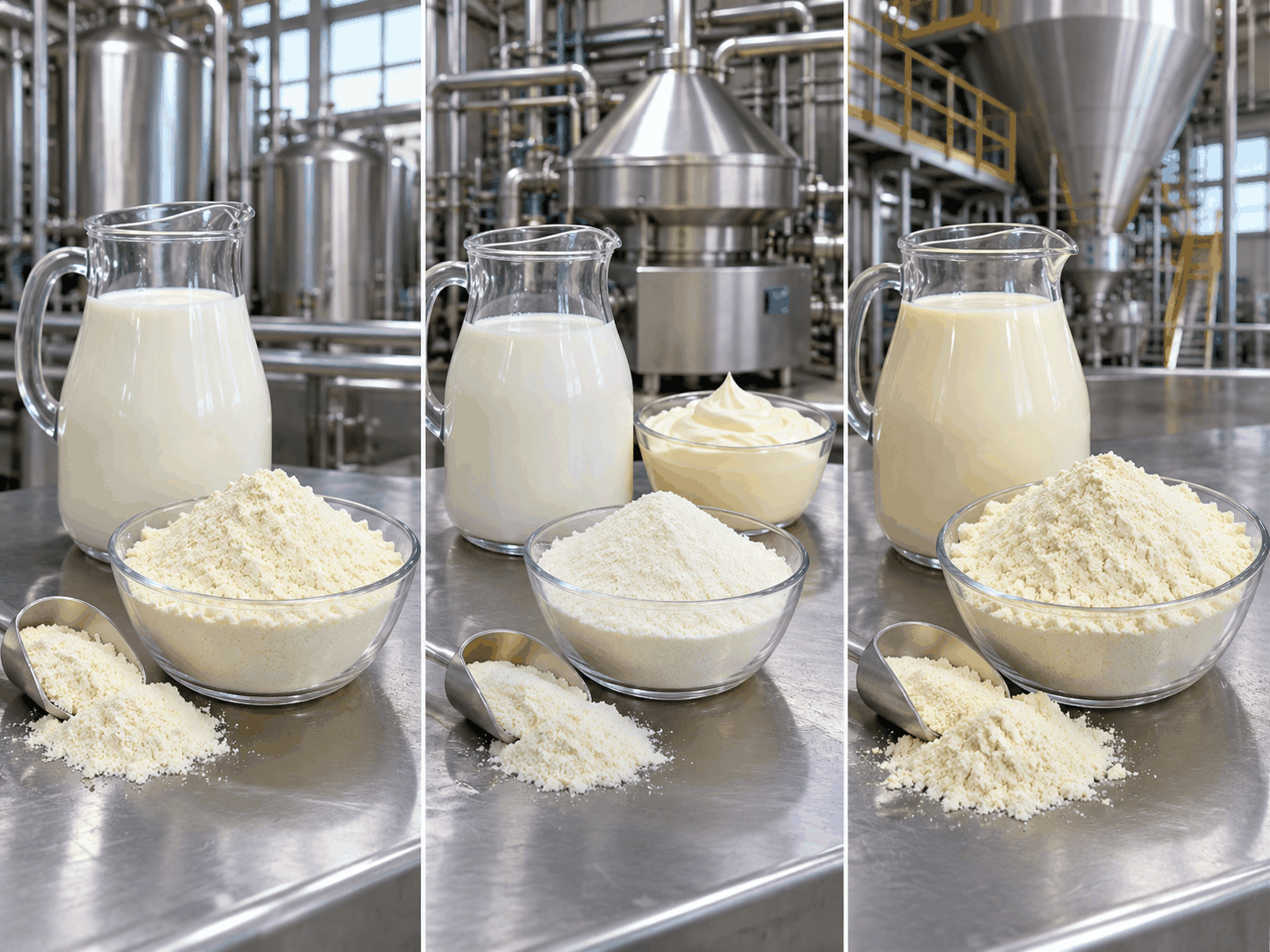
Scenario A — Whole Milk Powder (no separation)
- Fat stays in the milk: 10,000 kg × 12% total solids ≈ 1,200 kg solids
- After drying (powder keeps ~3% moisture): ≈ 1.2 tons whole milk powder
Scenario B — Skim Milk Powder (cream separated first)
- Fat removed: 10,000 kg × 3.2% = 320 kg fat → made into ~40% cream = ≈ 800 kg cream
- Remaining skim milk ≈ 9.2 tons, solids-not-fat ≈ 880 kg
- After drying: ≈ 0.9 tons skim milk powder + 800 kg cream
Scenario C — High-Solids Milk
- If your milk has 12.5–13% total solids (good-quality milk), yield can reach ≈ 1.2–1.3 tons
Key point: “1.1 tons of powder + 800 kg of cream” cannot happen at the same time — that would require the fat to exist twice. Whole-powder and skim-powder are two different operating modes.
3. The Yield Formula (Memorize This)
Milk powder yield = (milk solids, kg) ÷ (1 − powder moisture)
For skim powder: (10,000 × 8.8%) ÷ 0.97 ≈ 907 kg ≈ 0.9 tons
The ÷ 0.97 step is what most people miss: finished powder still contains ~3% water, so 880 kg of solids does not equal 880 kg of powder.
4. How Yield Determines Your Equipment (and Your Budget)
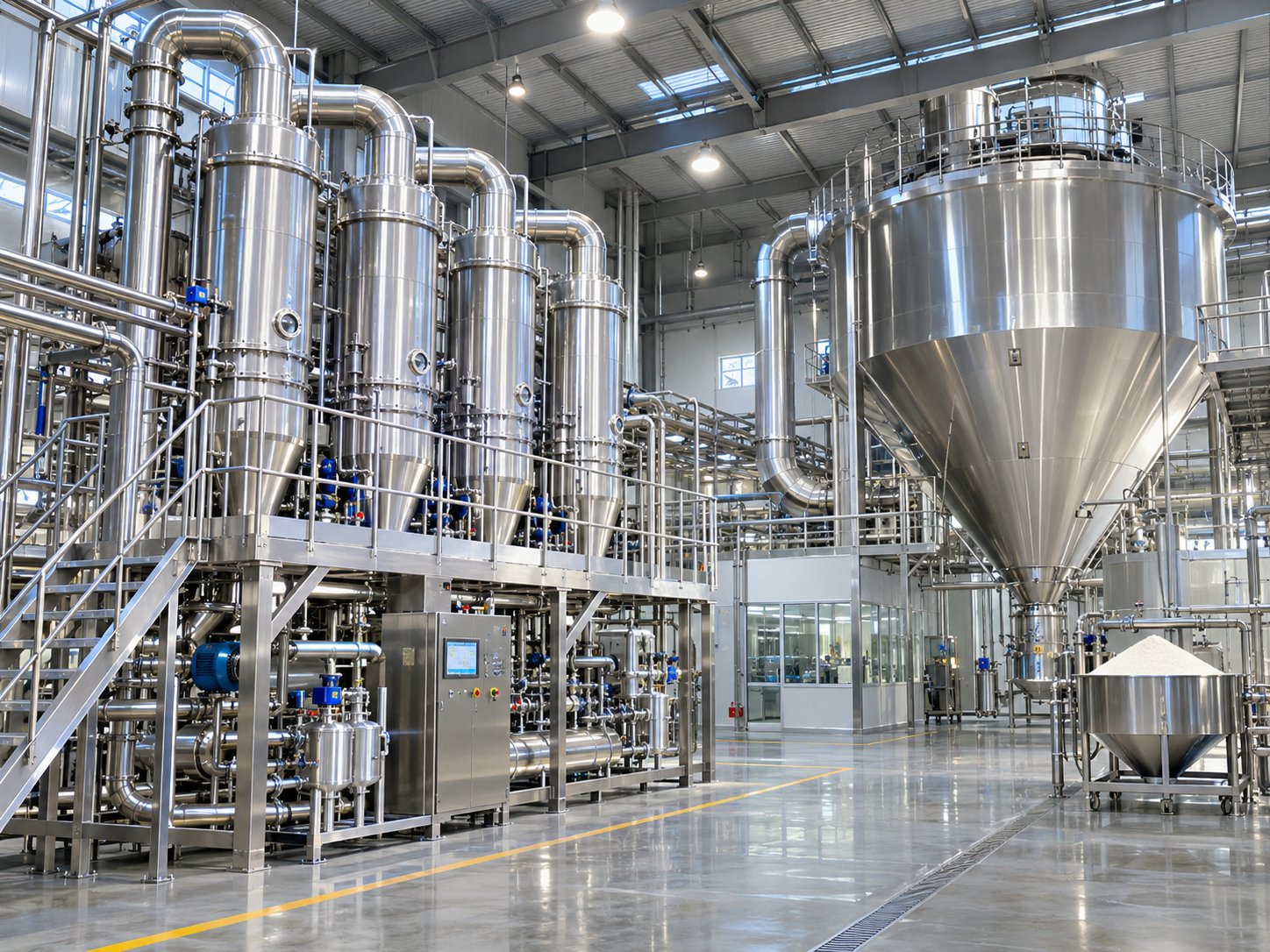
This single number decides the size of your two most expensive machines:
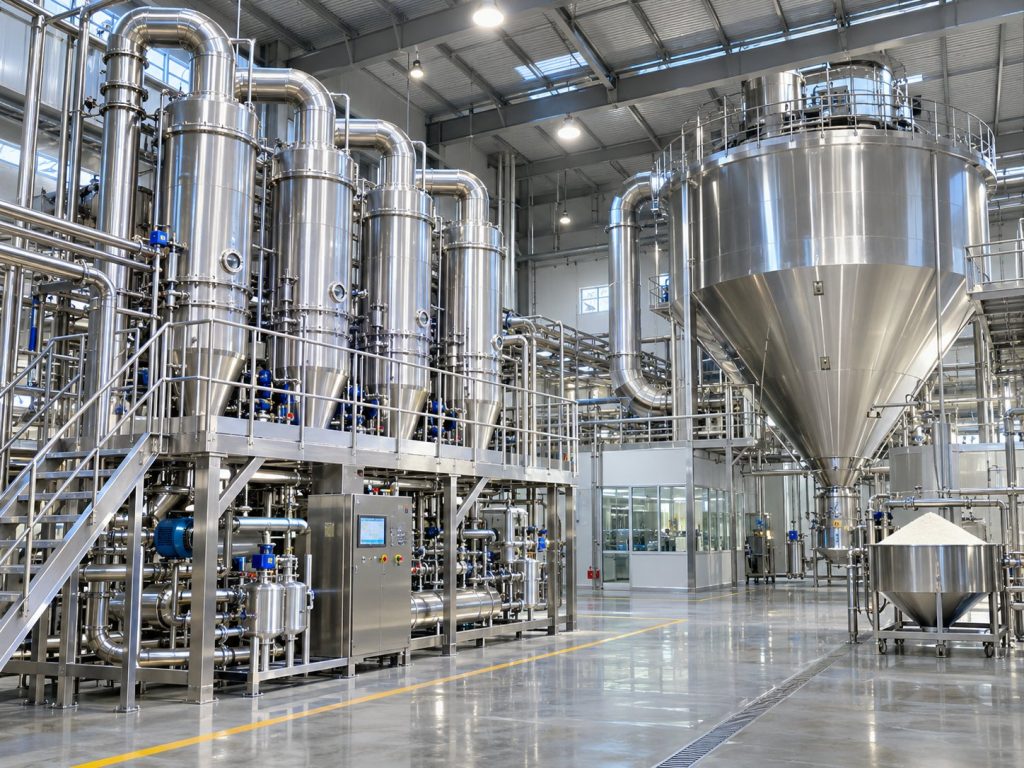
The Evaporator (removes water cheaply)
The evaporator concentrates milk from ~12% to ~45–50% solids. Its capacity is measured by water evaporation rate (kg/h or t/h), and its energy cost by steam consumption per ton of water evaporated:
| Configuration | Steam per 1 t water evaporated |
|---|---|
| Single-effect | ≈ 1.0–1.1 t |
| Double-effect | ≈ 0.55–0.6 t |
| Three-effect | ≈ 0.4 t |
| Three-effect + thermal vapor recompression (TVR) | ≈ 0.35–0.40 t |
The Spray Dryer (removes the last water expensively)
The spray dryer’s model number is its water evaporation capacity — e.g., a “220” tower evaporates 220 kg of water per hour. If the evaporator only reaches 40% solids (instead of 48%), the tower’s load jumps from ~68% to ~94% — nearly maxed out, with no room to expand.
This is why two “10 t/day” milk powder lines can differ by 200,000–300,000 RMB: one uses three-effect + TVR + a 220 tower with agglomeration (instant powder), the other uses single/double-effect + a smaller tower (base powder only).
5. The Process in Plain Terms: Skim → Concentrate → Dry
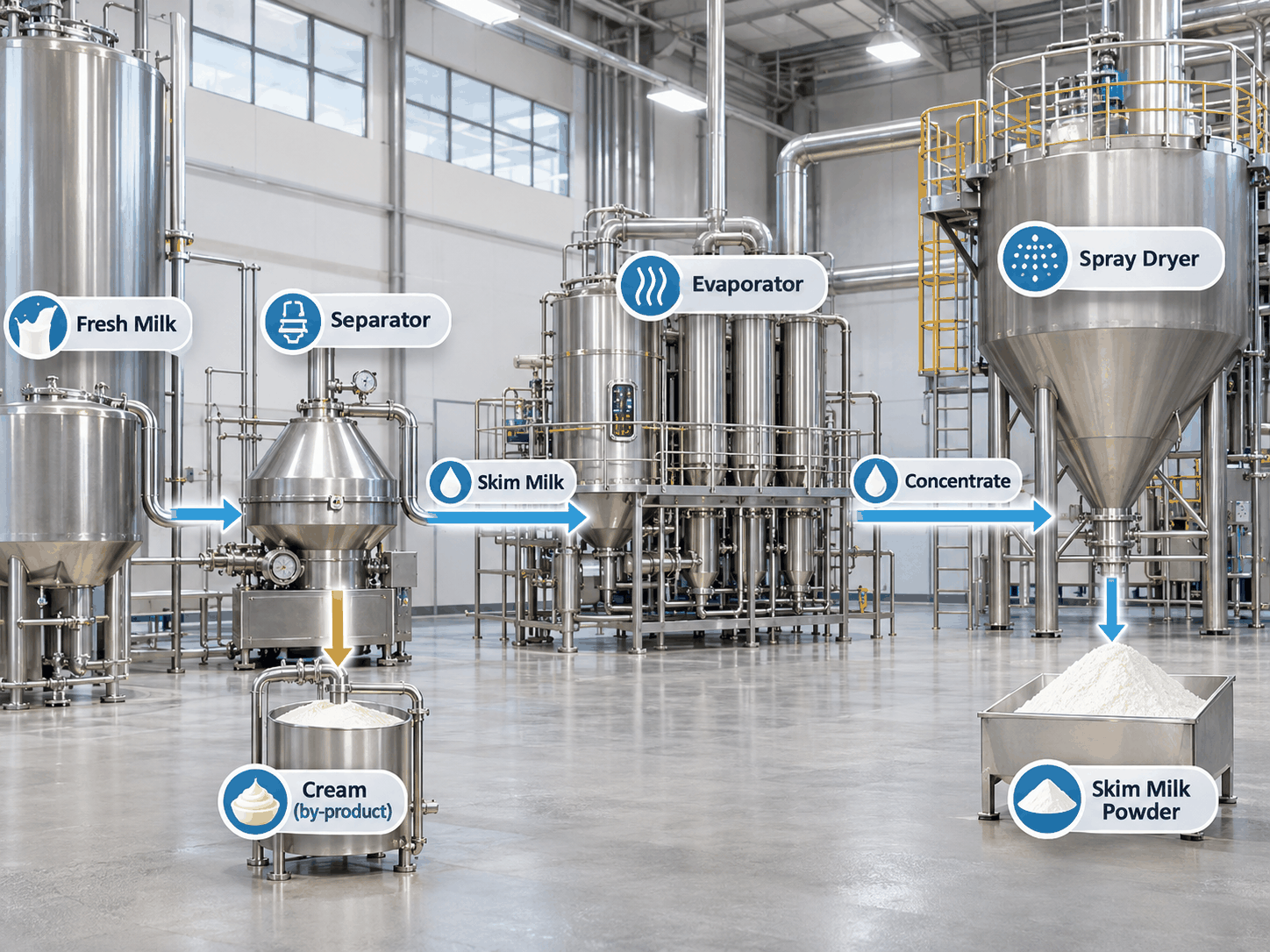
10 t milk
  ├─ Separator → 800 kg cream (sell or make butter)
  └─ 9.2 t skim milk
        ├─ Evaporator → 2 t concentrate (cheap water removal)
        └─ Spray dryer → 0.9 t skim milk powder (expensive water removal)
- Separator — skims off the cream (fat) first.
- Evaporator — boils off most of the water “like reducing a soup.”
- Spray dryer — sprays the concentrate into a fine mist and dries it with hot air.
6. FAQ
Q: How many tons of milk make 1 ton of powder?
About 8–11 tons of milk, depending on solids content and powder type. For whole powder: ~9 t; for skim powder: ~11 t.
Q: Why is my supplier quoting 1.1 tons when I want skim powder?
Because 1.1 tons is the whole powder figure. A skim line with a separator yields ~0.9 tons of powder plus ~800 kg of cream. Ask which operating mode the quote assumes.
Q: What is “solids content” and why does it matter?
It is the share of milk that is not water (fat + protein + lactose + minerals). Higher solids = more powder from the same milk = smaller equipment per kg of output. Always test your milk source’s solids and fat before sizing a line.
Q: Does the cream by-product have value?
Yes. Cream can be sold or further processed into butter, cream, or ice cream ingredients — often improving the project’s economics.
Q: How do I check a supplier’s yield claims?
Ask two numbers: the evaporator’s solids outlet (45–48% is correct for skim) and the dryer’s water evaporation rate. Then apply the formula above — any claim above the physical limit is inflated.
Get the Full Calculation Table (Free Download)
We have prepared a Milk Powder Yield Quick-Reference Table covering:
- Milk volume → powder yield (whole / skim / high-solids)
- Recommended evaporator and spray dryer sizing per output
- Steam consumption and energy cost comparison
Download it free by leaving your email below — and tell us your daily milk volume, and we will size a line for your exact output.
Download the Milk Powder Yield Table →
DAIROOL — small & medium dairy production lines: milk powder, cheese, butter, and multi-dairy. We help you buy the right line, not just the cheapest one.