
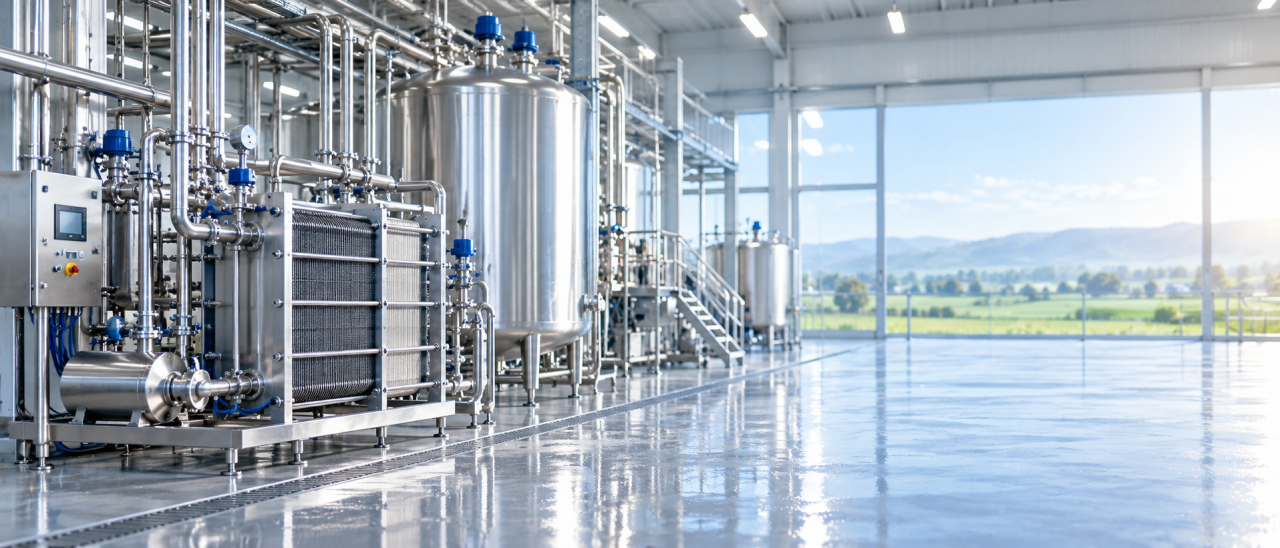
Hygienic Design / Dairy & Food Processing Equipment / Buying and Inspection Guide
Two mixing tanks may have the same nominal capacity and look almost identical, yet their quotations can differ by tens of thousands of yuan. What explains the higher price? Comparing tank dimensions, exterior finish and agitator motor power alone may overlook a more important question: after each production batch, can the equipment be cleaned, drained and inspected reliably before being returned to service?
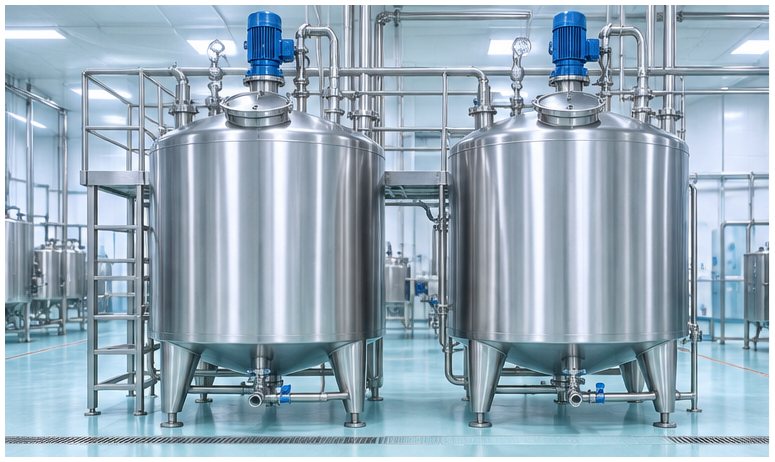
01 | You Are Buying More Than Capacity: Long-Term Cleanability
Hygienic design for dairy and food-processing equipment generally involves three linked considerations: whether cleaning solution reaches product-contact surfaces; whether liquid drains from the equipment after cleaning; and whether critical areas can be inspected and verified. If any one of these is overlooked, even a beautifully finished tank may require more manual cleaning and carry a greater risk of retained residues.
Price differences may therefore reflect tank-bottom geometry, weld and polishing quality, cleaning devices and associated piping, valves and seals, manway design, material grade, factory testing and delivery documentation. Buyers should request an itemized specification and quotation, then compare equipment under equivalent process conditions and supply scopes rather than judging by appearance alone.
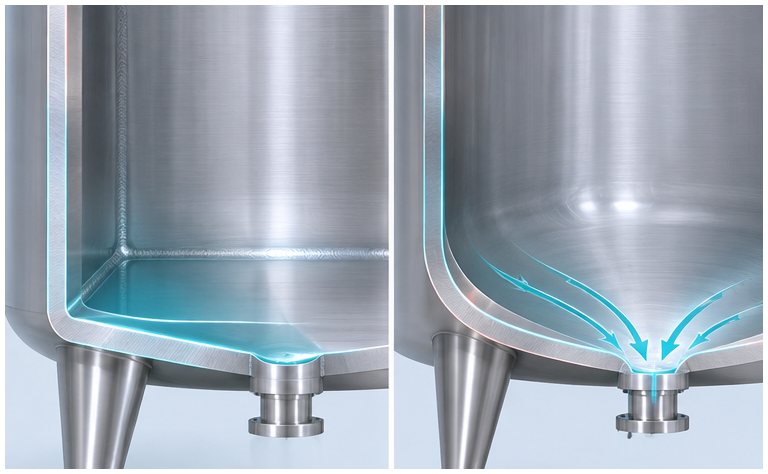
02 | Tank-Bottom Design: Radiused Corners and Drainability Matter
Where the tank wall meets the bottom, an excessively tight corner radius, poorly finished welds or localized depressions may allow liquid and product residues to collect. General EHEDG hygienic-design guidance favors generous internal radii, commonly recommending at least 6 mm; a 3 mm radius is cited as a minimum in that guidance. The appropriate detail still depends on the construction, operating conditions and cleaning validation.
The objective is not to pursue one radius figure mechanically, but to avoid difficult-to-clean areas on product-contact surfaces and create an effective drain path through the bottom, outlet valve and connections. Neither central nor offset outlets are automatically superior. Assess the actual low point, bottom-head geometry, agitator arrangement and installation level together.
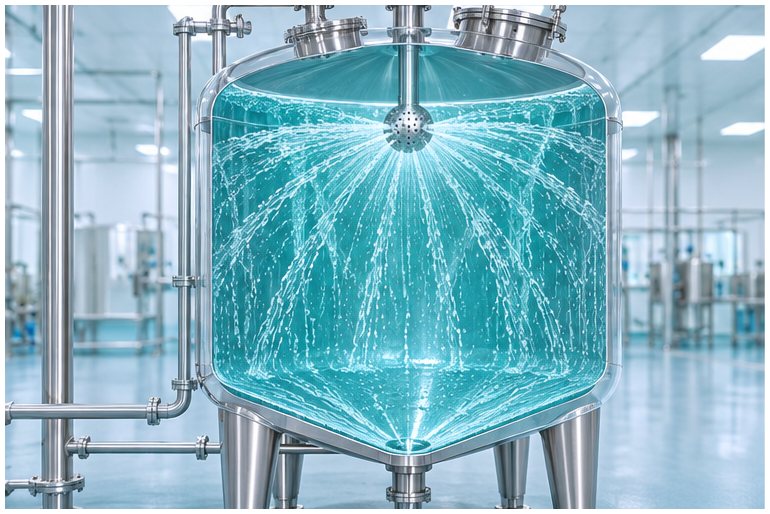
03 | CIP Cleaning: A Spray Ball Alone Does Not Guarantee Results
Installing a spray ball at the top of a tank is only one part of a clean-in-place (CIP) system. Effective internal coverage also depends on the vessel shape, the type, number and mounting height of cleaning devices, flow rate, operating pressure, shadowing from agitators or baffles, cleaning chemicals and the cleaning program. Both static spray balls and rotary cleaning devices have suitable applications; rotation alone is not proof of cleaning performance.
Tanks with a high height-to-diameter ratio or numerous internal fittings may face greater risks of cleaning shadow zones. Ask the manufacturer for the cleaning-device selection rationale, recommended operating parameters and, where needed, a cleaning-validation plan. Any coverage target should be established for the specific vessel, cleaning process and verification requirements, rather than treating one percentage as a universal mandatory standard for food-grade tanks.
04 | Manways and Fittings: Inspection Access Matters
A manway provides more than a viewing point: it also affects maintenance, component removal and localized manual cleaning. Its clear opening, position, lid-clearance space and safety arrangements should be chosen according to tank size, maintenance strategy and applicable regulations. A 400 mm diameter should not be treated as a universal pass/fail threshold. Any work requiring personnel to enter the tank must also comply with applicable confined-space entry procedures.
Manway necks, sight glasses, vent connections, level instruments and agitator-shaft seals are often overlooked during design reviews. Check whether connections create liquid-retaining pockets, whether seals can be cleaned and replaced, and whether product-contact areas contain unnecessary threads, crevices or potential routes for lubricant contamination.
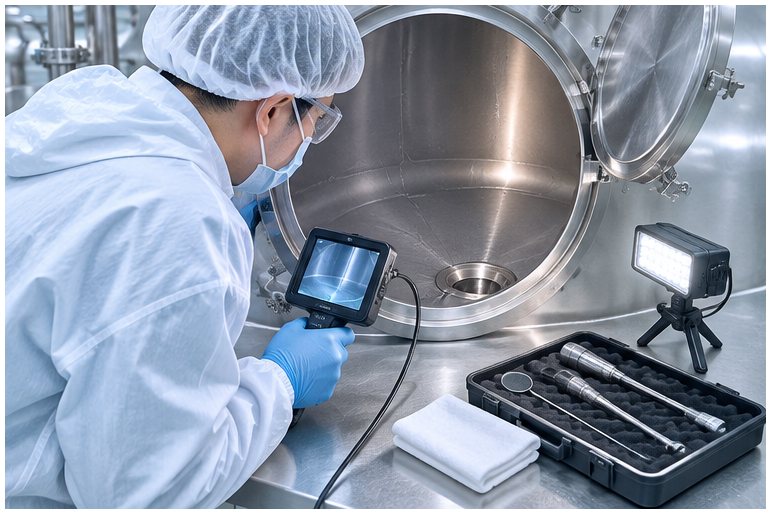
05 | Welds and Surface Finish: Shine Is Not an Acceptance Test
For product-contact surfaces, examine weld continuity and smoothness, along with pits, laps, crevices and transitions that are difficult to clean. Hygienic-design references commonly use Ra ≤ 0.8 μm as a benchmark for relevant product-contact surfaces, but the applicable equipment standard, purchase contract and process conditions take precedence. The direction of weld-grinding marks alone does not establish a so-called self-cleaning effect.
Where required by the contract, checks may include surface-roughness measurements and reviews of welding and material documentation. Neither stainless steel 304 nor 316L is categorically the best choice for every product. Selection should account for formulation, chloride exposure, cleaning-chemical concentrations, temperature and corrosion conditions.
06 | Equipment Acceptance: Turn Impressions into Verifiable Checks
Include the following items in the technical agreement before placing an order. For tanks designed for CIP, a riboflavin fluorescence test may be used when appropriate to help identify spray-coverage shadow zones. Final confirmation of cleaning effectiveness must also consider actual soil conditions, the cleaning cycle and relevant hygiene criteria.
| Item | Confirm Before Purchase | Acceptance / Evidence |
|---|---|---|
| Materials and surfaces | Material grade; product-contact finish | Material certificates; roughness / visual inspection |
| Bottom and outlet | Lowest point; drain path; valve connections | On-site drainage test; design drawing |
| CIP configuration | Device type; flow; pressure; shadow zones | P&ID; manufacturer data; coverage test if needed |
| Welds and seals | Internal welds; fitting interfaces; seal design | Weld inspection; seal specifications |
| Maintenance access | Manway location; clear opening; removal space | Drawings and safe-maintenance plan |
| Delivery documents | Installation; cleaning; maintenance; spare parts | Manuals; records and acceptance documents |
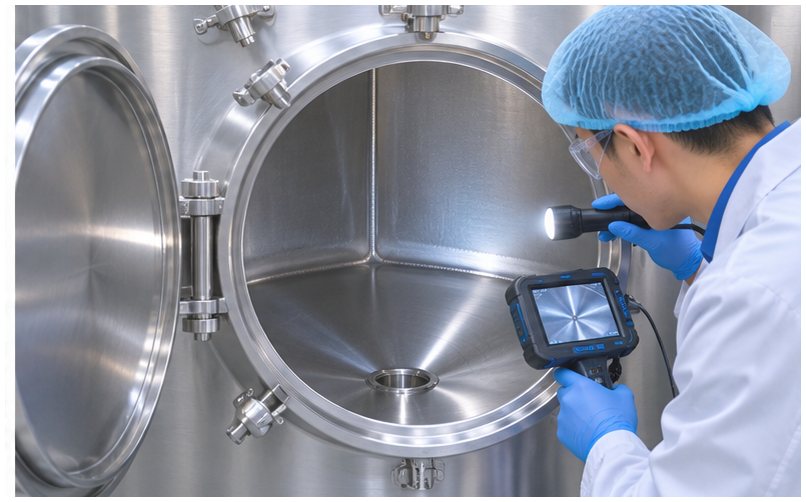
07 | Compare Total Cost of Ownership, Not Just Purchase Price
A lower purchase price does not necessarily mean a lower total cost. Poor hygienic design can increase cleaning time, maintenance downtime, manual reinspection and product losses. At the same time, sound design does not mean adding every available feature. Request quotations based on the same operating conditions and scope of supply, and identify which specifications materially affect long-term performance.
A worthwhile mixing tank is judged not only by how bright its finish looks, but by whether the hardest-to-reach areas can be cleaned, the lowest point can be fully drained and the most critical components can be inspected.
DAIROOL Advice | Four Questions to Ask Before Requesting a Quote
- What product will the tank handle, and what are its viscosity, operating temperature, acidity or alkalinity, and cleaning chemicals?
- How will the tank drain completely? Can the supplier provide a sectional drawing showing the low point in relation to the outlet valve?
- If CIP is required, what are the cleaning-device design parameters, and how will effective cleaning of critical areas be demonstrated?
- How will the contract specify surface quality, inspection procedures, technical documentation and after-sales maintenance?
DAIROOL supports equipment selection and production-line configuration for dairy and food-processing projects. We focus on matching equipment to the product process, cleaning method, plant utilities and future maintenance requirements—not simply comparing the appearance and nominal capacity of individual tanks.